
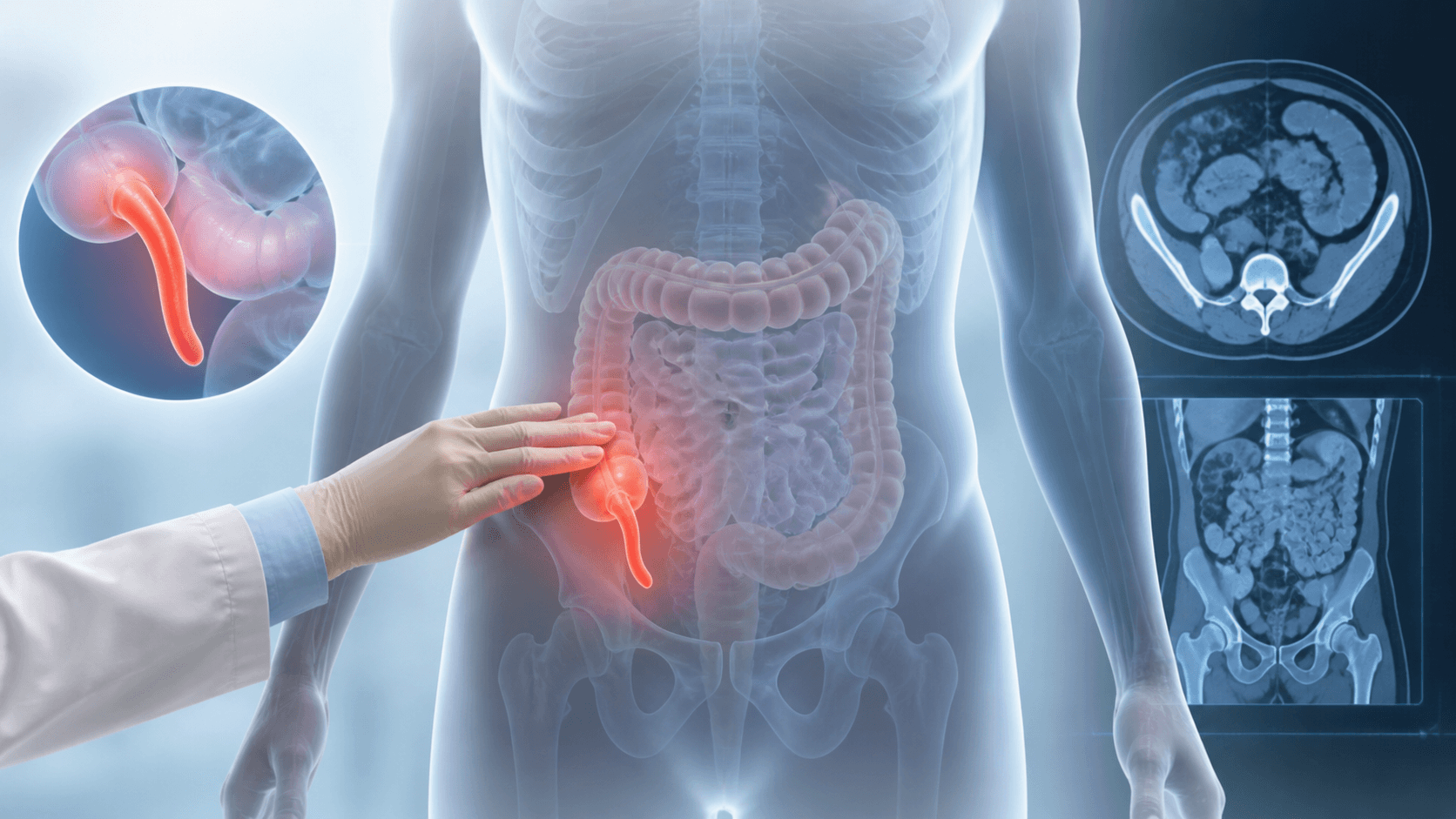
Abdominal pain is common, but appendicitis is one cause that should not be watched at home for too long. The appendix can become inflamed and infected, and delayed treatment increases the risk of rupture, abscess, peritonitis, and sepsis.
This guide explains appendicitis symptoms, the usual pain pattern, how symptoms may differ in children, pregnancy and older adults, which tests may be used, and when to go to an emergency department. It cannot confirm whether a person has appendicitis.
What Is Appendicitis?
The appendix is a small, finger-shaped pouch attached near the beginning of the large intestine. Appendicitis means that it becomes inflamed, often after its opening is blocked. The exact cause is not always clear. Swollen tissue, hardened stool, infection, or inflammatory bowel disease may be involved.
Once the appendix is blocked, pressure and infection can increase. Without prompt care, the wall may lose its blood supply and rupture. Appendicitis is therefore treated as a medical emergency.
Common Appendicitis Symptoms
The best-known pattern is pain that starts around the belly button and moves to the lower-right abdomen. The pain may:
- begin suddenly and become stronger over several hours;
- feel different from ordinary stomach discomfort;
- worsen when walking, coughing, sneezing, taking a deep breath, or travelling over bumps;
- become focused in the lower-right abdomen; and
- occur before nausea, vomiting, or fever.
Other possible symptoms include loss of appetite, nausea, vomiting, low fever, abdominal swelling, constipation, diarrhoea, inability to pass gas, and the feeling that a bowel movement might provide relief.
Not Everyone Has Typical Right-Sided Pain
The appendix can sit in different positions. Pain may be less clear in young children, older adults, pregnant patients, and people with certain anatomical differences. Pregnancy can shift the appendix upward as the uterus enlarges. An older adult may have less fever or tenderness despite serious disease.
Do not rule out appendicitis because one classic sign is absent. A clinician must examine the full pattern.
Appendicitis or Another Cause of Abdominal Pain?
| Possible cause | Common clues | Why examination matters |
|---|---|---|
| Appendicitis | Increasing pain, often moving to lower right; poor appetite; nausea or fever | Delay can lead to rupture |
| Stomach infection | Vomiting or diarrhoea may be prominent; several people may be ill | Dehydration and other conditions must be considered |
| Kidney stone | Severe wave-like side pain, possibly moving to groin; urinary symptoms | Imaging and urine testing may be needed |
| Urinary infection | Burning urine, frequent urination, lower abdominal discomfort | Kidney infection may cause fever and side pain |
| Gallbladder problem | Upper-right pain, often after a fatty meal | Can become infected or block bile ducts |
| Gynaecological emergency | Pelvic pain, missed period, bleeding or pregnancy possibility | Ectopic pregnancy or ovarian problems may be urgent |
A table cannot diagnose the cause. More than one condition can produce similar pain, and serious illness can initially appear mild.
When to Go to Emergency Care
Seek urgent assessment for abdominal pain that is progressively worsening, does not go away, or moves toward the lower right. Go immediately for:
- severe or rapidly increasing abdominal pain;
- a hard, swollen, or very tender abdomen;
- repeated vomiting or inability to keep fluids down;
- fainting, confusion, severe weakness, or breathing difficulty;
- high fever or chills;
- blood in vomit or stool;
- pain during pregnancy or with a possible pregnancy;
- pain in a young child who cannot describe it; or
- pain that suddenly improves and then returns across the whole abdomen.
A brief reduction in pain does not always mean recovery. If a severely inflamed appendix ruptures, pain may temporarily change before widespread abdominal pain develops.
What Not to Do at Home
- Do not repeatedly press the painful area to “test” it.
- Do not use laxatives or enemas for unexplained severe abdominal pain.
- Do not apply a very hot pad over the abdomen.
- Do not take leftover antibiotics.
- Do not eat a heavy meal when urgent surgery may be possible.
- Do not delay care while waiting for the pain to reach a specific location.
Tell the emergency team what medicines were taken and when. A pain medicine may be appropriate under medical guidance; pain relief does not prevent doctors from evaluating the cause.
How Doctors Diagnose Appendicitis
History and Physical Examination
The clinician asks when pain began, where it moved, what makes it worse, and whether nausea, fever, urinary symptoms, bowel changes, or pregnancy possibility are present. The abdomen is examined gently for tenderness, guarding, swelling, and other signs.
Blood Tests
A complete blood count may show increased white cells, and C-reactive protein may indicate inflammation. Blood tests can also check dehydration, kidney function, electrolytes, and other possible problems. Normal results do not always exclude early appendicitis.
Urine and Pregnancy Testing
Urinalysis helps look for urinary infection or kidney stones. For patients who could be pregnant, pregnancy testing is important because ectopic pregnancy can cause life-threatening abdominal pain and influences imaging choices.
Ultrasound
Ultrasound uses sound waves and has no ionising radiation. It is often the first imaging test for children, young adults, and pregnant patients. Sometimes the appendix cannot be seen clearly, so the result must be combined with the examination and other tests.
CT or MRI
A CT scan can show an enlarged or ruptured appendix, inflammation, abscess, or another cause of pain. MRI may be used in selected situations, including pregnancy, when available and appropriate. Doctors balance diagnostic benefit with radiation, contrast, pregnancy status, and clinical urgency.
How Is Appendicitis Treated?
Doctors commonly treat appendicitis with antibiotics and removal of the appendix, called an appendectomy. The operation may be laparoscopic, using small cuts and a camera, or open through a larger incision. The surgical team chooses the approach based on the patient’s condition, anatomy, previous operations, and whether rupture or widespread infection is present.
Some carefully selected uncomplicated cases may be managed initially with antibiotics, but recurrence can occur and surgery remains the standard treatment in many situations. This choice requires imaging, surgical review, and reliable follow-up. It should not be made at home.
What Happens If the Appendix Has Ruptured?
A ruptured appendix can cause peritonitis, an infection of the abdominal lining, or an abscess. Treatment may include urgent surgery, drainage of pus, intravenous antibiotics, fluids, pain control, and close monitoring. Recovery may be longer than after early uncomplicated treatment.
Recovery After Appendix Surgery
Many people recover fully. The team may encourage walking, wound care, gradual return to food, and avoiding strenuous activity for a period. Seek review after surgery for increasing fever, worsening pain, redness or discharge from the wound, persistent vomiting, abdominal swelling, breathing difficulty, or inability to pass stool or gas.
Follow the surgeon’s instructions because recovery differs after laparoscopic versus open surgery and after a ruptured appendix.
Appendicitis in Children
A child may not point to the lower-right abdomen. Warning signs can include refusing food, vomiting, fever, unusual quietness, difficulty walking upright, crying with movement, or pain that keeps getting worse. Diarrhoea does not exclude appendicitis.
Infants and young children can worsen quickly. Persistent abdominal pain with lethargy, dehydration, repeated vomiting, or fever needs prompt paediatric assessment.
Appendicitis During Pregnancy
Pregnancy itself can cause nausea or abdominal discomfort, which makes diagnosis challenging. Appendicitis can occur in any trimester. New persistent abdominal pain, fever, vomiting, or marked tenderness requires urgent obstetric and surgical evaluation. Do not avoid care because of concern about tests; clinicians select imaging and treatment with maternal and fetal safety in mind.
Preparing for the Emergency Department
- Note when the pain began and how it moved.
- Carry a list of medicines, allergies, operations, and medical conditions.
- Mention the last meal and drink.
- Tell the team about pregnancy possibility and the last menstrual period when relevant.
- Bring previous scans or test reports.
- Do not drive yourself if the pain is severe, you feel faint, or strong medicine has been taken.
Appendicitis Care in Varanasi
Infinity Care Hospital lists 24×7 emergency services, general surgery and laparoscopy, radiology, pathology, critical care, anaesthesia, and paediatrics. Learn more about its general surgery and laparoscopy department or use the department finder. Suspected appendicitis should be assessed urgently rather than booked as a distant routine appointment.
Frequently Asked Questions
Can appendicitis pain come and go?
Early pain can vary, but pain that progressively worsens or returns needs medical assessment. Do not use temporary relief as proof that the appendix is normal.
Can appendicitis cause diarrhoea?
Yes. Some patients have diarrhoea or constipation. Bowel symptoms do not rule appendicitis in or out.
Can a blood test alone confirm appendicitis?
No. Blood tests can show inflammation but do not identify the cause by themselves. Diagnosis uses symptoms, examination, lab tests and imaging.
Will ultrasound always show appendicitis?
No. Ultrasound is useful, especially in children and pregnancy, but the appendix may not be visible. Further observation or imaging may be needed.
Can appendicitis be prevented?
There is no guaranteed prevention method. The most important protective step is prompt assessment when suspicious symptoms occur.
Can you live normally without an appendix?
Yes. Most people live normally after recovery from appendectomy and do not need a special lifelong diet.
Key Takeaway
Appendicitis often starts with increasing abdominal pain that may move from the belly button to the lower-right side, but symptoms vary. It is a medical emergency because rupture can occur. Do not self-test, use laxatives, or wait for every classic sign. Prompt examination and appropriate imaging lead to safer treatment.
Medical note: This information does not replace emergency assessment. Severe or worsening abdominal pain requires urgent medical care.